
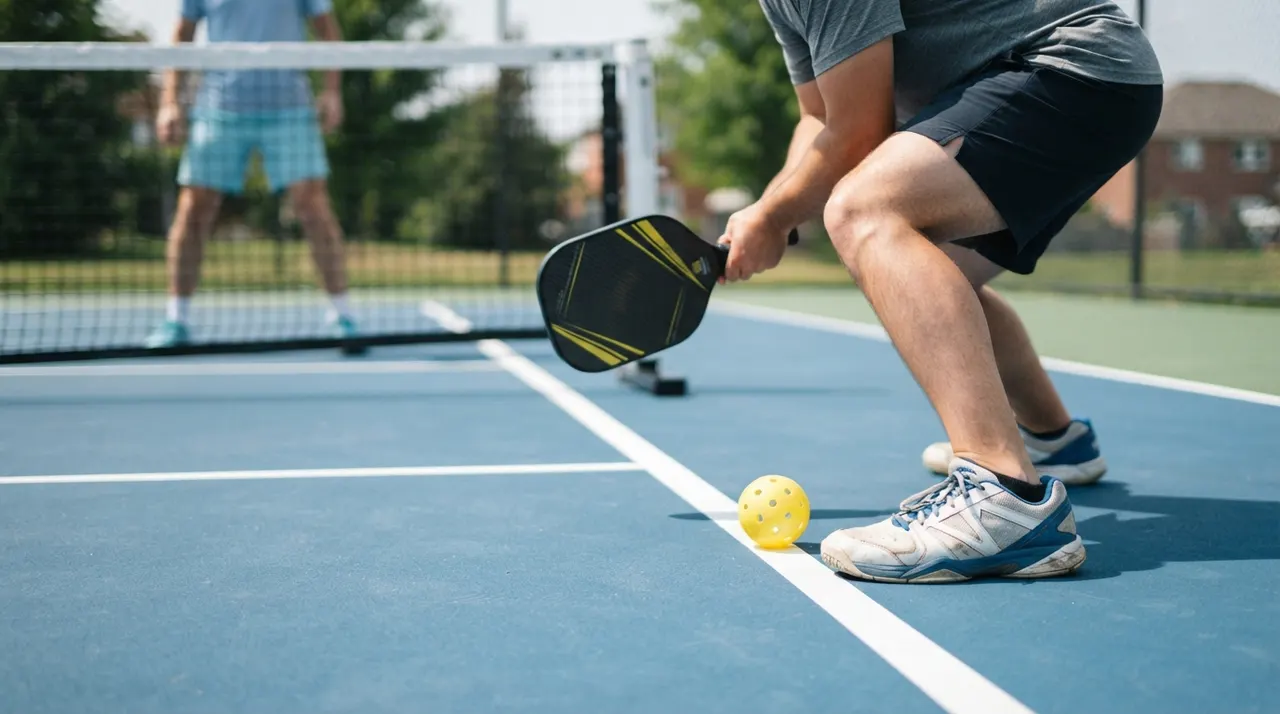
Pickleball rules for beginners in plain English — scoring, the two-bounce rule, and the kitchen, explained the way a coach teaches them in a first lesson.
Pickleball rules for beginners really come down to three ideas: an underhand serve, a two-bounce start to every point, and a no-volley zone at the net called the kitchen. Everything else is detail. The rules have a reputation for being confusing — mostly because of how the scoring is called out — but taught in the right order they take about ten minutes. Here they are, explained the way we teach them in a first lesson.
The serve: underhand, diagonal, one try
You serve underhand — paddle below your waist, swinging upward — from behind the baseline, diagonally into the service box across the net. The serve must clear the kitchen and its line; landing anywhere in the correct box after that is good. Unlike tennis, you get one attempt, not two, and only the serving team can score points in traditional scoring. That last part is the rule that shapes everything: winning a rally as the returning team doesn't score — it wins you the serve, which is your licence to start scoring.
The two-bounce rule: why nobody rushes the net immediately
The ball must bounce once on each side before anyone may volley (hit it out of the air). Serve bounces, return bounces — then volleys are allowed. That's it, but it quietly runs the whole opening of every point: the serving team has to hang back for the return's bounce, which is why the returning team gets to the net first, and why the serving team's famous 'third shot' is such a big deal. When you watch experienced players, this rule is the choreography you're seeing.
The kitchen: the rule everyone gets wrong
The seven-foot zone on each side of the net is the non-volley zone — the kitchen. The rule: you may not volley while touching it. You can stand in the kitchen all day; you can step in and hit balls that have bounced (that's the dink game); what you can't do is hit a ball out of the air with a foot on or inside the line — including stepping in on your follow-through momentum. It exists so nobody can camp at the net smashing everything, and it's why pickleball has a soft game at all.
Scoring, decoded
- Games go to 11, win by 2. Only the serving team scores.
- The three numbers you hear ('4-2-1') are: your team's score, their score, and whether you're your team's first or second server.
- In doubles, both partners serve before the ball passes to the other team — except the very first service turn of the game, which gets one server only.
- Serve from the right side when your score is even, left when it's odd. If that helps you remember nothing else, it will rescue you mid-game constantly.
Nobody learns pickleball scoring from an article — including this one. You learn it by playing three games with patient people. Read this, then go lose track of the score like everyone else did at the start.
The unwritten rules (so you feel like a regular)
A few courtesies that aren't in any rulebook but run every friendly court in Vaughan: call the score out loud before you serve — it's how everyone (including you) keeps track, and forgetting is normal, asking is fine. Call balls on your own side honestly, and give the benefit of the doubt to your opponents on close ones. If a ball rolls onto your court from next door, stop play and return it; if yours escapes, call 'ball on!' so nobody turns an ankle. And after every game, win or lose, everyone taps paddles at the net. Do those four things and you'll be welcome in any open-play rotation from day one.
Lines, faults, and what to ignore for now
Balls on the line are in — except a serve touching the kitchen line, which is a fault. Rallies end on a ball hit out or into the net, a double bounce, or a kitchen violation. That's genuinely enough to play; wrinkles like around-the-post shots live in the official rulebook and can wait. If you'd rather have all of this shown than read — with a coach calling the score out loud until it clicks — that's week one of our beginner pickleball Learn-to-Play program, and you'll be playing real games by week four. Already booked something? Here's what to expect from a first lesson, and once you're playing, the five most common beginner mistakes is your next read.
References
- USA Pickleball — Essential Rules Summary
- Pickleball Canada — Basic Rules (serve, two-bounce, kitchen)
- USA Pickleball — 2026 Official Rulebook (PDF)
This article is general educational information, not professional, medical, or purchasing advice. External links are provided for reference; Vaughan Pickleball Tutor is not affiliated with and does not endorse any third-party brand or organization listed.