Pickleball drills at home that actually transfer to matches — wall drills, paddle-control work, and footwork patterns you can run in a garage or driveway.
Pickleball drills at home are how players in Ontario survive the winter — and how the fastest improvers quietly outpace everyone else year-round. You don't need a court, a partner, or a machine: a wall, a paddle, a few balls, and ten minutes a day will measurably sharpen your hands and your soft game. The catch is that most at-home practice is aimless bouncing that trains nothing. Here are the drills that actually transfer to match play, in the order we assign them as lesson homework.
The wall is your best practice partner
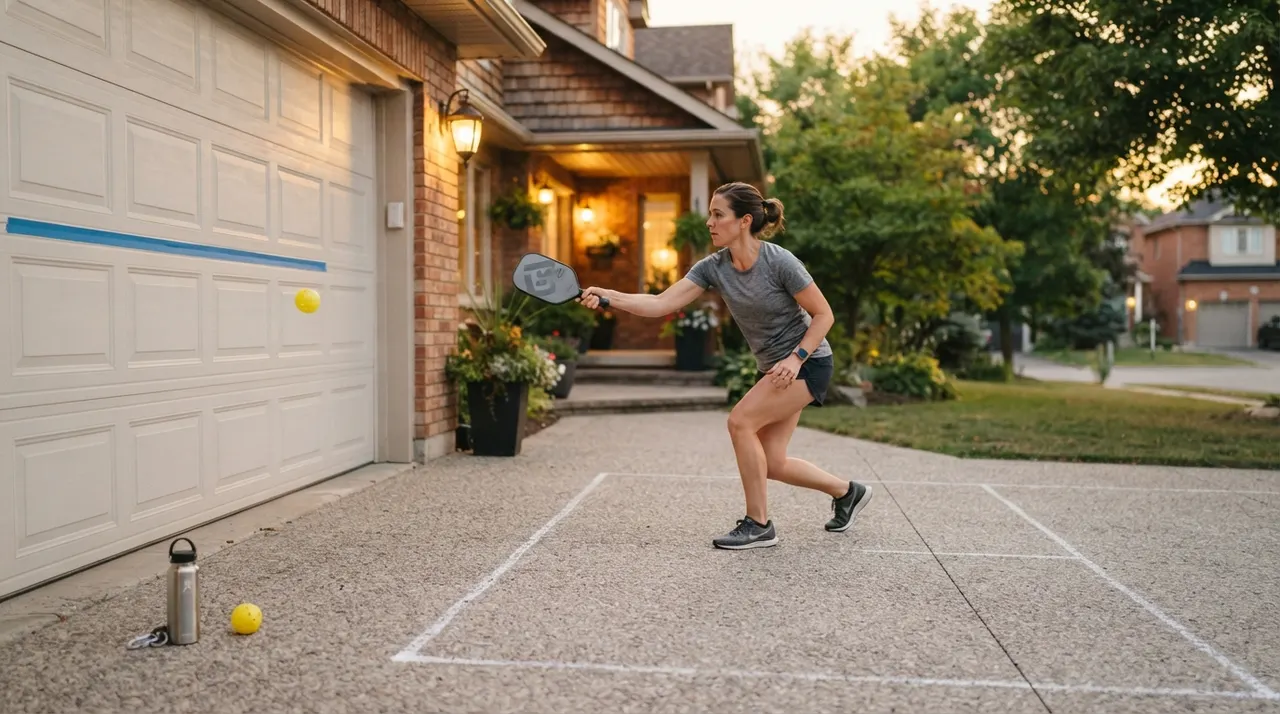
A garage door, basement wall, or school wall returns every ball with zero complaints. Stand about seven feet away — kitchen-line distance — and mark a line on the wall at 34 inches, net height. Now the wall is an opponent who never misses, which is exactly what your dinks and volleys need: hundreds of repetitions of the same soft contact. A tip that saves frustration: indoor balls or a slightly deflated foam ball rebound slower off a hard wall and keep rallies controllable in tight spaces.
The five drills worth your ten minutes
- Wall dinks — soft shots that hit above your net line and come back to you in one bounce. Goal: 50 in a row without reaching or lunging. This is the single highest-transfer drill on the list.
- Wall volleys — closer in, no bounce, paddle up in front of your chest. Alternate forehand and backhand; 30 clean volleys builds the quick hands that win kitchen firefights.
- Reset touch — have the wall 'attack' you by hitting one firm ball, then soften the rebound into a gentle dink. Firm-soft-firm-soft. Resets are the hardest shot to practise anywhere else.
- Paddle-face control — bounce the ball on your paddle: 25 forehand-side, 25 backhand-side, then alternating, then edge of the paddle if you're feeling ambitious. Silly-looking, genuinely effective for contact feel.
- Shadow footwork — no ball at all: split-step, two shuffles left, dink motion, recover; repeat right. Ten reps each side trains the movement pattern that keeps you balanced at the line.
Ten focused minutes against a wall, five days a week, beats a two-hour open-play session for skill development — the wall gives you more quality contacts in ten minutes than most games do in an hour.
Make it deliberate or don't bother
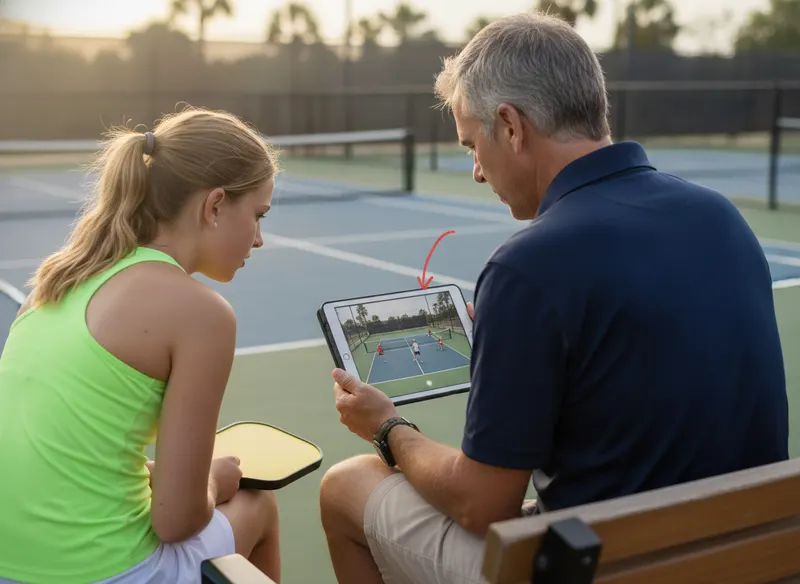
The difference between practice and noise is a target and a count. 'Hit the wall for a while' trains nothing; '50 consecutive dinks above the line, softer than yesterday' trains touch. Keep score against yourself, and when a drill gets easy, shrink the target or add movement — boredom is the signal to progress the drill, not to quit it. And match the drill to your actual weakness: if your problem is popping up attackable balls, it's the reset drill; if you're slow at the kitchen, it's volleys and footwork. Not sure what your weakness is? That's precisely what filming your own games answers in one session.
A simple weekly plan
Structure beats enthusiasm, so here's the routine we assign as lesson homework: Monday, Wednesday, Friday — five minutes of wall dinks, three of volleys, two of resets; ten minutes, done. Tuesday and Thursday — paddle-face control while the kettle boils and one set of shadow footwork. Weekends are for actual play, where you'll notice the wall work showing up within two weeks, usually as volleys you suddenly have time for. Total weekly cost: about forty minutes and zero dollars — the best ratio in the sport.
What home practice can and can't do
The wall builds touch, hands, and consistency — it cannot teach shot selection, positioning, or pressure, which only live opponents provide. That's the honest division of labour: home drills sharpen the tools, court time teaches you when to use them, and the players who improve fastest do both on purpose. It's also, frankly, the cheapest way to speed up the timeline from beginner to good. When you're ready to pressure-test what the wall built — third-shot drops, resets under fire, real dink battles — that's what our advanced pickleball drills and strategy sessions are for: game-speed reps, live opponents, and a coach telling you which pattern to take home to the wall next.